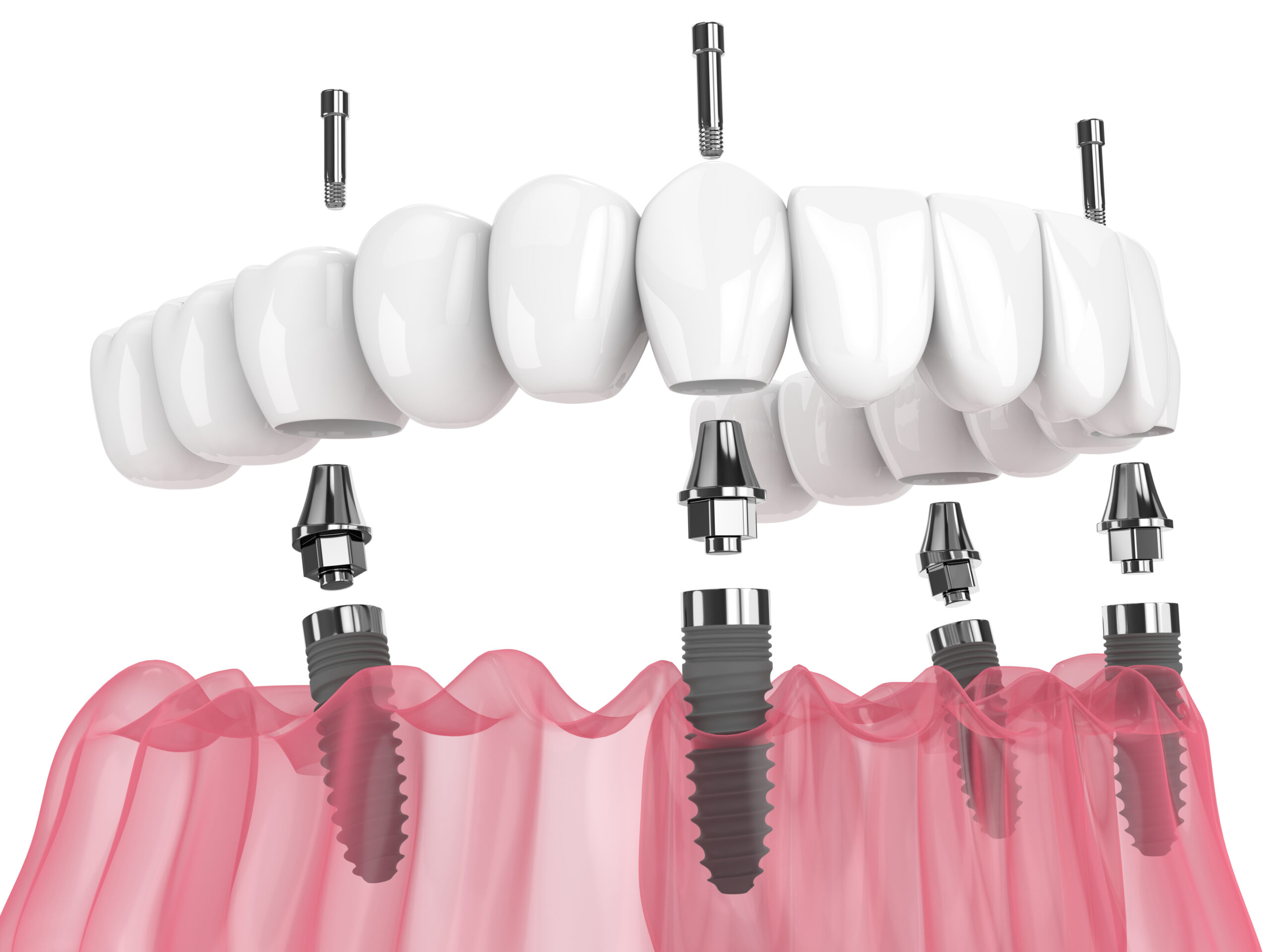
When you’re facing extensive tooth loss or failing teeth, choosing the right replacement solution affects your daily life, budget, and long-term oral health. Two popular options are full arch replacement with All-on-4 implants and traditional individual implants. Both offer permanent solutions, but they work in different ways and serve different needs.
The right choice depends on how many teeth you’re replacing, the condition of your jawbone, your timeline for treatment, and your budget. Let’s break down how these two approaches differ and what factors should guide your decision.
What Are Traditional Dental Implants?
Traditional dental implants replace individual missing teeth or groups of teeth. Each implant consists of a titanium post surgically placed into your jawbone, an abutment that connects to the post, and a crown that looks and functions like a natural tooth. If you’re replacing a single tooth, you’ll receive one implant. For multiple missing teeth, you may need several individual implants or an implant-supported bridge.
The process typically takes several months because the implant must fuse with your jawbone before the final restoration can be attached. This integration process, called osseointegration, creates a strong foundation that can last for decades. Traditional implants preserve your remaining natural teeth since they don’t require support from adjacent teeth like bridges do.
What Is All-on-4?
All-on-4, also known as teeth in a day, is a full arch restoration technique that replaces all your upper or lower teeth using just four strategically placed implants per arch. The back implants are angled to maximize contact with your existing bone, which often eliminates the need for bone grafting procedures. You receive a temporary set of teeth on the same day as your implant surgery, allowing you to leave with a functional smile.
This approach works well if you’ve lost most or all of your teeth in one arch, or if your remaining teeth are failing and need extraction. The four implants support a fixed prosthesis that you cannot remove, but your dental team will clean during regular checkups.
Comparing Treatment Timelines
The timeline difference between these two options can be significant. Traditional implants typically require:
- Initial implant placement surgery.
- Three to six months of healing for osseointegration.
- Additional time if you need bone grafting or sinus lifts first.
- Final crown or bridge placement after healing is complete.
All-on-4 offers a faster process:
- Extraction of any remaining teeth (if needed) and implant placement on the same day.
- Immediate placement of temporary teeth.
- Return visit after three to six months to receive your permanent prosthesis.
If you’re working within a specific timeframe, whether for an upcoming event, travel plans, or simply wanting to return to normal eating and speaking quickly, the immediate function of All-on-4 can be appealing.
Bone Loss Considerations
Your jawbone density plays a major role in determining which option suits you best. Traditional implants generally require adequate bone height and width at each implant site. If you’ve experienced significant bone loss, you may need grafting procedures before implant placement, which adds time and cost to your treatment.
All-on-4 was designed to work around bone loss. The angled back implants take advantage of the denser bone toward the front of your jaw. This strategic placement often allows patients with moderate bone loss to receive implants without grafting. However, if bone loss is severe, you may still need grafting even with All-on-4, or you might be better served by traditional implants with proper bone preparation.
Douglas L. Johnson, D.M.D., a Board Certified oral and maxillofacial surgeon, performs implant procedures under IV sedation for patient comfort at St. Augustine Oral & Facial Surgical Center, an AAAHC-accredited facility.
Which Option Best Fits Your Situation?
Consider traditional implants if you:
- Have lost only some of your teeth and want to preserve your remaining natural teeth.
- Have good bone density that doesn’t require extensive grafting.
- Prefer a staged approach where you can address teeth as problems arise.
- Want the ability to replace individual teeth in the future without affecting others.
Consider All-on-4 if you:
- Need to replace most or all teeth in one or both arches.
- Want a faster timeline from consultation to final teeth.
- Have moderate bone loss that makes traditional implants more complex.
- Prefer a single comprehensive treatment rather than multiple procedures over time.
- Are working with a tighter budget but still want a permanent solution.
Making Your Decision With St. Augustine Oral & Facial Surgical Center
Your individual health factors also play a role. Conditions like uncontrolled diabetes, active gum disease, or heavy smoking can affect healing and implant success rates regardless of which option you choose. Addressing these factors before any implant surgery improves your outcomes. The good news is that dental implants have a success rate of 95% when placed by trained professionals in patients with good oral health.
The team at St. Augustine Oral & Facial Surgical Center can evaluate your specific situation through a comprehensive examination and imaging. We’ll assess your bone density, remaining teeth, oral health, and personal goals to recommend the approach that best serves your needs. Dr. Johnson performs all implant procedures under IV sedation at our AAAHC-accredited facility, and our team of certified surgical assistants and registered APRN will support you throughout your treatment. Schedule a consultation and discuss which implant option is right for you.
